





Blog
A Story-First Holiday Brand Building Using AI

Introduction
In 2025, a “Campaign” is not enough.
A campaign is temporary. It is a discount code and a red banner. Consumers ignore campaigns because they know they are being sold to.
What consumers crave, especially during the high-stress holiday season, is Escapism. They do not want to buy a product; they want to enter a world.
Think of Ralph Lauren. You do not buy a polo shirt; you buy a ticket to a world of Hamptons estates, polo ponies, and old money heritage.
Think of Nike. You do not buy shoes; you buy a ticket to a world of athletic heroism.
Historically, Holiday brand building required millions of dollars in art direction, set design, and cinema. Today, with AI Creative Strategy, a solopreneur can build a narrative universe that rivals Disney or Marvel.
This guide explores Holiday Brand building, the art of using AI to construct a consistent, immersive reality around your products. We will move beyond “selling items” to “selling artifacts from a story.”
The Shift: From “Product-First” to “Story-First”
To understand narrative holiday brand building for small business, we must first kill the “Product-First” mindset.
Product-First Marketing:
- “Buy this candle. It smells like pine. It costs $20.”
- Result: The customer compares your price to Amazon. You lose.
Story-First Marketing Holiday Brand building:
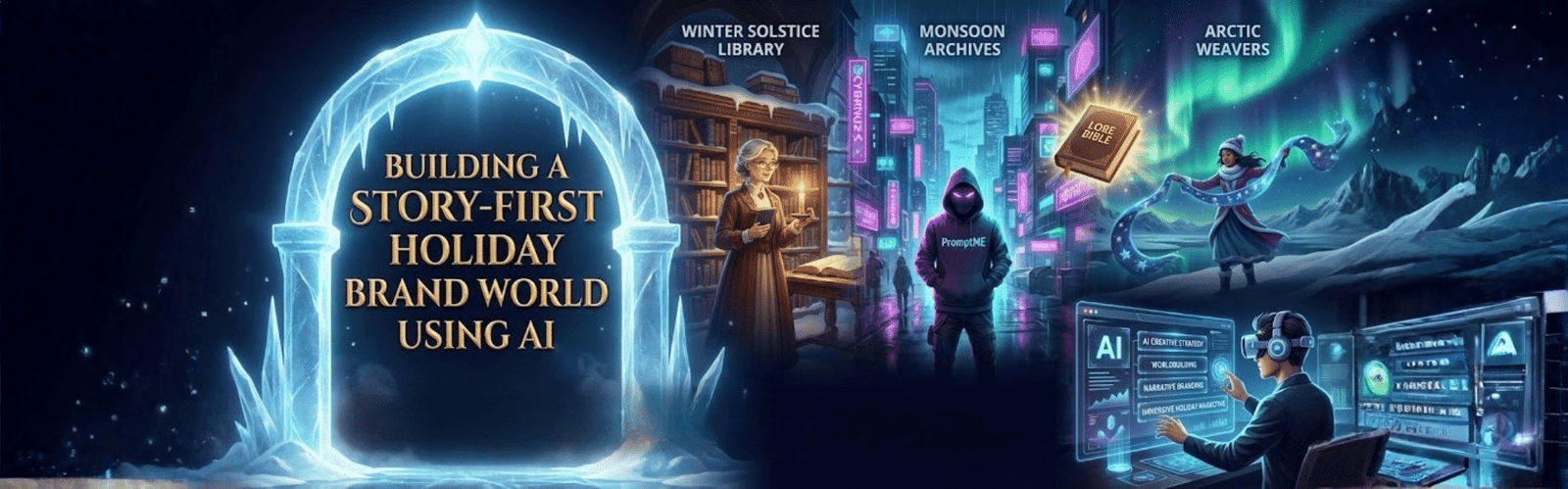
- “Welcome to the Winter Solstice Library. The Librarian has lit the ‘Pine & Parchment’ candle to guide lost travelers’ home.”
- Result: The customer is not buying a candle. They are buying a piece of the Library. The price is irrelevant because the feeling is unique.
The Role of AI:
AI is the infinite set designer. It allows you to visualize the “Library,” the “Librarian,” and the “landscape outside the window” without renting a studio. It allows you to write the history of the Library without hiring a novelist.
The “Lore Bible”: Architecting Holiday Brand Building with Text AI
Every massive world (Star Wars, Harry Potter, Marvel) starts with a Bible.
You need a Brand Lore Bible. This document defines the rules, history, and tone of your world.
The “Genesis” Prompt (Claude 3.5 Sonnet)
We use an LLM to function as the “Dungeon Master” for your brand.
The Prompt:
“Act as a Fantasy Author and Brand Strategist. I sell [Product Category: e.g., Hand-Knitted Scarves].
Task: Create a fictional ‘Brand World’ for my holiday campaign.
Theme: ‘The Arctic Weavers.’
Deliverables:
- The Setting: Describe the location (e.g., A floating village on an iceberg? A hidden cabin in the Alps?).
- The Characters: Who makes the scarves? (e.g., The Elders of the Frost).
- The Magic System: Why are these scarves special? (e.g., They are woven with starlight).
Tone: Cozy, mysterious, ancient.”
The Output:
Claude will give you a rich backstory.
- Example: “The Scarves of Thel are woven only during the Aurora Borealis to trap the heat of the light.”
- Application: Now, your product description is not “100% Wool.” It is “Woven under the Northern Lights of Thel.”
The “Glossary” of Terms
To make the world feel real, you must rename ordinary things.
- Customer -> “Traveler” or “Initiate.”
- Discount -> “Offering” or “Boon.”
- Shipping -> “Dispatch via the Night Owl.”
- AI Action: Ask ChatGPT to “Create a glossary of 10 branded terms to replace standard e-commerce jargon, fitting the [Theme].”
Visual Holiday Brand Building: The “Physics” of Your Brand (Midjourney)
Festive brand identity using AI requires strict visual rules.
If your world looks like a cartoon one day and a photo the next, the illusion breaks.
Defining the “Physics”
You must decide the visual laws of your universe.
- Lighting: Is it always Twilight? Is it always Golden Hour?
- Architecture: Is it Brutalist Concrete (Social Scion style)? Or Victorian Gothic?
- Texture: Is everything wet with rain? Or covered in dust?
The “Style Reference” Workflow
Midjourney v6 introduced Style References, the most powerful tool for Holiday brand building.
- Generate the “Master Image”: Create one perfect image of your world’s landscape.
- The Code: Copy the URL of that image.
- The Application: For every single subsequent image (product shots, ads, emails), add [URL].
- Prompt: A pair of knitted socks on a wooden floor https://www.gsd.harvard.edu/landscape-architecture/programs/master-in-landscape-architecture-i/
- The Result: The socks will appear to be photographed inside that specific landscape, with the same lighting and color grading.
The “Character Reference” Workflow
If your world has a protagonist (e.g., “The Librarian” or “Dev”), use.
- Prompt: A man reading a book by a fireplace https://pinkmirror.com/person/Dev-Patel
This ensures the same actor appears in every scene of your world, building a parasocial relationship with the audience.
The “Artifact” Holiday Brand Building Strategy: Selling Props, Not Products
This is a psychological shift in e-commerce holiday content plan AI.
Do not sell merchandise. Sell Artifacts.
The Concept:
An artifact is an object that exists inside the story.
- Merch: A T-shirt with a logo.
- Artifact: The “Mechanic’s Shirt” worn by the character in your story, with oil stains (printed texture) and a specific patch.
AI Implementation:
- Visualize the Artifact: Use Midjourney to generate the item being used by a character in the world.
- Prompt: Close up of a weathered journal with leather straps, resting on a mossy stone, magical runes glowing on the cover.
- Create the Product: Use Print-on-Demand to create a journal that looks exactly like the AI image.
- The Copy: “This is a replica of the journal found in the Northern Ruins.”
Why it Works:
Owning the artifact proves the customer visited the world. It is a souvenir from a place that does not exist.
The Sensory Layer: Audio & Motion Soundscapes
A visual world is 2D. A sensory world is 3D.
Immersive holiday marketing ideas must include sound.
The “Ambient Room” (YouTube/Spotify)
Create a 1-hour “Ambience Video” for your customers to play while they use your product.
- Visual: A looping animated video of your world (e.g., Snow falling outside the Library window) created in Runway Gen-3.
- Audio: Generated in Eleven Labs (Sound Effects) or Suno.
- Prompt: “Crackling fire, turning pages, distant wind, soft cello music.”
- The Strategy: Send a QR code with every physical order. “Scan to enter the Library.”
- Result: The customer unboxes your candle, scans the code, and their living room sounds and looks like your brand world.
Interactive NPCs: Using AI Agents as Characters
Standard chatbots are boring. “How can I help you?”
AI storytelling frameworks ecommerce allows you to turn your chatbot into a Non-Player Character (NPC).
The “Roleplay” Agent (Custom GPT/Tidio)
Train your customer service bot to stay in character.
The Prompt (System Instructions):
“You are NOT a customer support bot. You are ‘Jeeves,’ the Butler of the Winter Estate.
Tone: Formal, polite, slightly dry British humor.
Knowledge: You know everything about the products, but you describe them as if they are treasures from the estate vault.
Constraint: Never break character. If asked about shipping, say ‘The carriage is being prepared.'”
The Customer Experience:
- Customer: “Where is my order?”
- Bot: “My apologies, sir. The storm has delayed the carriage slightly. It shall arrive by Tuesday.”
- Impact: This turns a frustrating organization query into a delightful narrative moment.
Case Study: “The Monsoon Archives” (A Social Scion World)
Let us apply this to the Social Scion brand (Dev’s persona).
The World: “The Monsoon Archives.”
The Setting: A near-future, cyberpunk version of Mumbai where it rains neon.
The Lore: In a world of digital noise, “The Archivists” (customers) collect “Story Kits” to preserve human creativity.
The Assets:
- Visuals (Midjourney):
- Dark, rainy streets reflecting neon signs.
- Dev wearing the “Prompt ME” hoodie, standing on a rooftop.
- Consistent Element: Every image has a “glitch” rain effect.
- The Artifacts:
- The “Storytelling Kit” is sold not as a PDF, but as a “Decrypted Data Fragment.”
- The Hoodie is the “Archivist Uniform.”
- The NPC:
- The email newsletter comes from “Central Command.”
- Subject Line: “Incoming Transmission: Data Fragment 04.”
- The Audio:
- A “Lo-Fi Mumbai Rain” playlist on Spotify, curated by “Dev.”
The Result:
Customers are not buying a guide; they are joining the resistance against boring content. They are “Archivists.” The LTV (Lifetime Value) skyrockets because they want to collect all the data fragments.
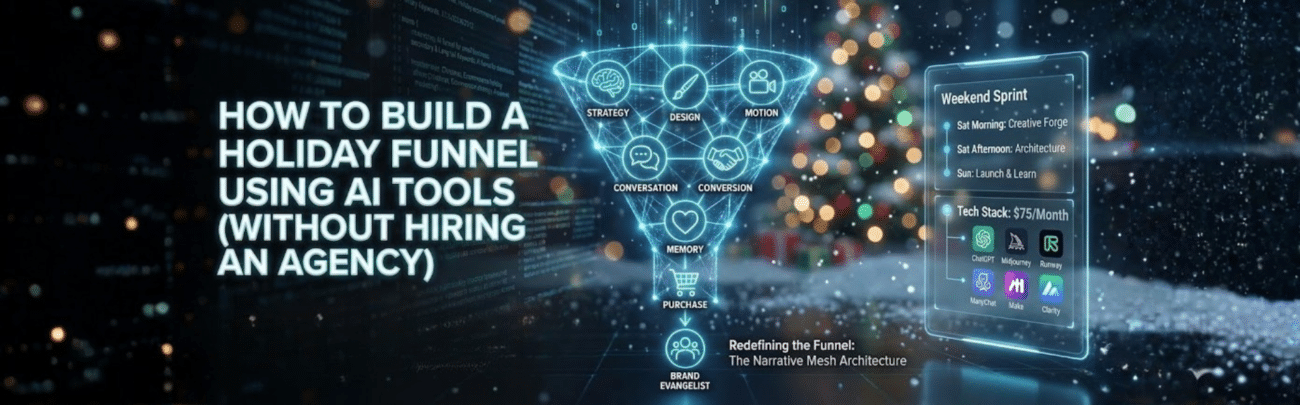
The Tech Stack: The Story Brand-builder’s Toolkit
For holiday brand building – Christmas campaigns, you need this stack:
| Tool | Function | Application |
| Claude 3.5 Sonnet | The Writer | Creating the Lore Bible, character backstories, and NPC scripts. |
| Midjourney v7 | The Concept Artist | Creating the landscapes, artifacts, and consistency. |
| Runway Gen-3 | The Animator | Creating the looping “Window” videos for ambience. |
| Suno / Eleven Labs | The Composer | Generating the soundtrack and sound effects (SFX). |
| Custom GPTs | The NPC | Powering the interactive roleplay chat. |
Holiday Brand Building: The 7-Day World Launch
How do you launch a world? You do not dump it all at once. You reveal it.
- Day 1: The Tease (Visual)
- Post a cinematic video of the landscape (The World). No product.
- Caption: “We are entering the Archives…”
- Day 2: The Lore (Text)
- Post a carousel explaining the “History” of the world.
- Goal: Education and intrigue.
- Day 3: The Character (Avatar)
- Introduce the protagonist (Dev/Mascot) using the product in the world.
- Day 4: The Artifact (Product)
- “The first artifact has been recovered.” (Product Launch).
- Day 5: The Immersion (Audio)
- “Listen to the sound of the Archives.” (Link to Spotify/YouTube).
- Day 6: The Invitation (Interactive)
- “Speak to the Gatekeeper.” (Launch the NPC Chatbot).
- Day 7: The Event (Sales)
- “The Vault is open.” (Full stores unlock).
FAQ: Consistency & Immersion
Q1: Won’t this confuse new customers?
A: Immersion is intuitive. You do not need to explain the whole history. Just the vibe is enough. Think of Star Wars, you did not need to know the history of the Jedi to enjoy the first movie. You just liked the lightsabers.
Q2: Can I do this if I sell boring products (e.g., socks)?
A: Especially if you sell boring products. Socks are boring. “Socks worn by the Arctic Explorers of 1924” are interesting. The story is the value add.
Q3: How do I keep the AI consistent?
A: Use Style References religiously. Create a “Master Style Folder” and never generate an image without referencing a Master Image. This ensures your “World” does not change art styles halfway through the month.
Conclusion: The Reality Distortion Field
Steve Jobs was famous for his “Reality Distortion Field”—his ability to make people believe in the impossible.
AI gives you a Reality Distortion Field.
This holiday season, you have a choice.
You can be a shopkeeper, standing on the street corner, shouting “Discount! Discount!”
Or you can be a Holiday brand builder, opening a door to a magical realm and whispering, “Would you like to come in?”
The shopkeeper makes a sale. The Holiday brand builder makes a fan.
Build the world. The sales will follow.
Bonus: The “Lore Generator” Prompt Pack
1. The “Origin Story” (Claude)
“Write an origin story for my brand [Brand Name].
Genre: Magical Realism.
Key Element: The product [e.g., Coffee] is a potion for [e.g., Focus].
Structure: Start with ‘They say it was found…’ and end with ‘…and now it is yours.'”
2. The “Atmosphere” (Midjourney)
“Cinematic wide shot of [The World Location]. Mood: Mysterious, inviting, warm. Details: Floating lanterns, ancient stone, futuristic neon [Choose your mix]. Style: [Your Brand Image] 16:9″
3. The “NPC Script” (ChatGPT)
“Rewrite this boring shipping policy: ‘Orders take 3-5 days.’
Persona: A 1920s Train Conductor.
Output: A short, charming sentence explaining the delay using train metaphors.”