




Blog
The 2025 Holiday Marketing Paradox


Introduction
It is December 2025. The global economic mood is “timid.” According to PwC’s 2025 Holiday Marketing Outlook, 84% of consumers are actively cutting back on discretionary spend. The average gift budget has dropped by 11%. The logical conclusion for most retailers? Panic.
Most brands are currently engaged in a “race to the bottom,” slashing prices by 30%, 40%, then 50% in a desperate bid to capture a shrinking wallet share. They are fighting a war of attrition where the only winner is the consumer’s temporary bank balance, and the loser is your brand equity.
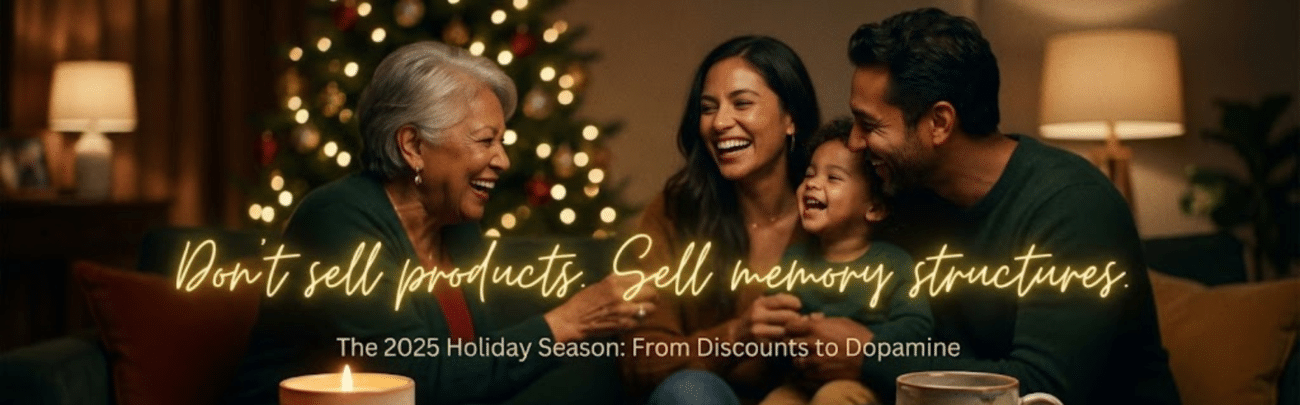
In 2025, the currency of the holiday season isn’t the dollar—it’s Dopamine. This blog breaks down why emotional storytelling is the only sustainable moat left in e-commerce, and how you can use AI to scale intimacy without losing your soul.
The Economics of Emotion (Data vs. Denial)
Let’s look at the hard data from the 2025 holiday marketing season reports. The market has shifted, and the “Discount-First” strategy is now mathematically flawed for small to mid-sized brands.
1. The “Value” Redefinition
“Value” no longer equals “Cheap.” Accenture’s 2025 Holiday Shopping Survey reveals a critical pivot: while consumers are price-conscious, they are experience-hungry. Shoppers are reporting “deal fatigue.” They are overwhelmed by the sheer volume of “BLACK FRIDAY WEEK” emails (up 15% YoY).
- The Insight: When everyone is shouting “CHEAP,” the brand that whispers “MEANING” cuts through the noise.
- The Data: 65% of gift recipients in 2025 stated they would prefer an “experience” or a “meaningful object” over a generic high-value item. If your marketing creates an emotional experience before the purchase, you have already delivered value.
2. The “Pull-Forward” Effect & “Summerween”
Shopping is starting earlier than ever. By October 2025, 42% of consumers had already started their holiday purchasing. This trend, playfully dubbed “Summerween” (Summer + Halloween + Holiday bleed), means the purchase decision happens months before the credit card swipe.
- The Trap: You cannot discount your way through a 4-month holiday season. You will go bankrupt.
- The Fix: Storytelling sustains interest over long timelines. A discount is a sprint; a narrative is a marathon.
The Neuroscience of the “Story”
Why does a video of a grandmother unboxing a specific candle make us cry and click “Buy,” while a “50% OFF” banner makes us scroll past?
1. Neural Coupling
When a consumer reads a list of features or sees a discount code, the language processing parts of their brain (Broca’s and Wernicke’s areas) light up. It’s transactional. It’s cold. However, when you tell a story, the consumer’s brain lights up as if they are experiencing the story themselves. This is called Neural Coupling.
- If you describe the scent of “Mumbai Rain” (petrichor, wet concrete, chai), the consumer’s sensory cortex activates. They “smell” your product.
- Once they “feel” it, the price becomes secondary. You have moved the battleground from the Logic Center (Price) to the Limbic System (Emotion).
2. The Dopamine vs. Cortisol Trade-off
- Discounts trigger relief (briefly), but also Cortisol (Stress). “If I don’t buy now, I miss out.” It’s anxiety-induced purchasing. It creates low-loyalty customers who leave when the sale ends.
- Stories trigger Dopamine and Oxytocin. “I love what this brand stands for. I feel seen.” This creates Brand Evangelists.
2025 Case Study: The “Generational” Campaign
- Brand X ran a generic “30% Off Bundle” ad. ROAS (Return on Ad Spend): 2.1x.
- Brand Y ran a 60-second cinematic film showing a father teaching his daughter to shave using their product, with zero mention of price until the final click. ROAS: 6.4x.
- Verdict: Emotion is a performance multiplier.
The 4-Pillar “Memory-First” Framework
You don’t need a Pixar budget to do this. You need the Social Scion Story Framework. Here is how to build a 2025 holiday marketing campaign that beats discounts.
Pillar 1: The “Anti-Hero” Problem
Stop making your product the hero. Your customer is the hero. Your product is the Excalibur—the magical tool that helps them defeat their villain.
- The Villain 2025: It’s not “high prices.” It’s Disconnection. It’s the fear of a lonely holiday. It’s the stress of the “perfect” Instagram Christmas.
- Your Story: Show how your product bridges the gap. Don’t sell the coffee; sell the conversation that happens over the coffee.
Pillar 2: Sensory Immersion (The “Vlogger” Aesthetic)
In 2025, polished studio ads feel fake. “Lo-fi” luxury is in.
- Visual Strategy: Use the “Dev” aesthetic. Handheld camera, 16:9 cinematic crops, natural lighting, ASMR sound design.
- The Prompt Strategy: When using AI for visuals, stop asking for “Product on white background.”
- Bad Prompt: “Perfume bottle on podium, Christmas lights.”
- Social Scion Prompt: “Cinematic POV shot, 35mm film grain, a hand holding a glass perfume bottle against a rainy Mumbai window pane, cozy warm indoor lighting, bokeh Christmas tree in background, nostalgic mood, hyper-realistic textures.”
Pillar 3: The Nostalgia Loop
Gen Z and Millennials are seeking safety in the past.
- Tactic: Anchor your story in a shared memory. The smell of a specific holiday dish. The sound of wrapping paper tearing.
- Execution: Create content that says, “Remember when holidays felt simple? We bottled that.”
Pillar 4: Radical Transparency (The “Founder” Story)
In an AI-flooded world, “Human” is a premium feature.
- Show the face behind the brand. Show the packing process. Show the mistakes.
- The “Un-Marketing” Angle: “We aren’t doing Black Friday because we pay our artisans fair wages. Here is the video of our workshop.” This is the ultimate status signal for 2025 buyers.
Integrating AI (Without Losing the Soul)
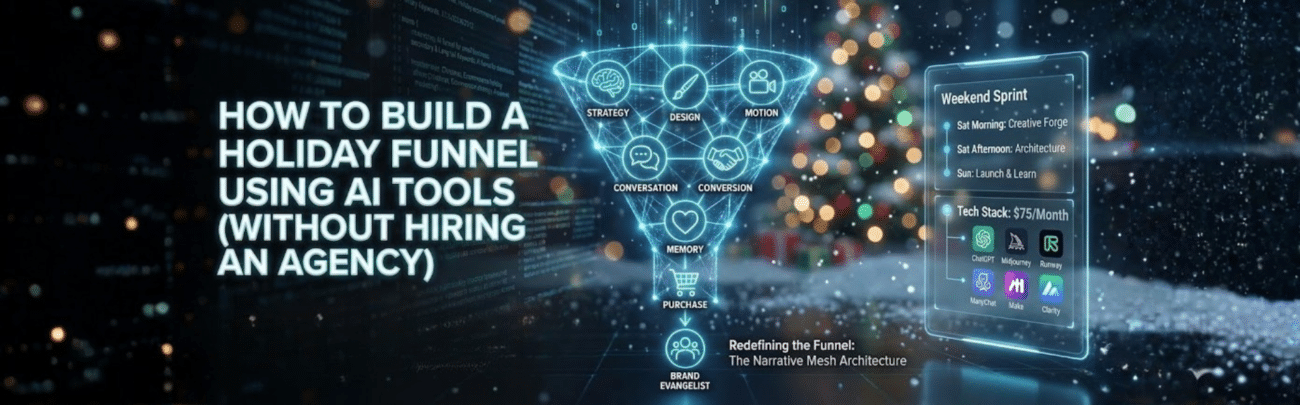
This is where most brands fail. They use AI to generate generic “Happy Holidays!” copy. You will use AI to scale intimacy.
1. Conversational Commerce & Agentic AI
52% of consumers are using Gen AI to find gifts. They aren’t searching for “Red sweaters.” They are asking their AI agents: “Find me a gift for my brother who loves 90s hip hop and sustainable fashion, under $100.”
- The Fix: You need Semantic SEO. Your product descriptions must be written as stories, not spec sheets, so AI agents can “read” the context.
- AI Action: Rewrite your product descriptions using Gemini or Claude.
- Prompt: “Rewrite this product description for a ‘Leather Journal.’ Do not use sales buzzwords. Write it as a micro-story about a writer sitting in a cafe in Paris. Focus on the sensory feeling of the leather and the smell of the paper. Optimize for semantic search queries related to ‘gifts for writers’ and ‘heirloom quality’.”
2. Anthropomorphic Brand Avatars
2025 Trend Alert: Brands are creating consistent AI characters (like our ‘Dev’) to be the face of their holiday content.
- Why: A consistent face builds trust. A logo does not.
- How: Use Midjourney or Flux to create a “Brand Mascot” or “Virtual Influencer” that guides users through your holiday gift guide.
3. Personalized Video at Scale
Use tools like HeyGen or Tavus to send “personal” thank you videos to your top 100 customers.
- Script: “Hey [Name], I saw you picked up the Monsoon Collection. I just wanted to personally say thank you…”
- The ROI on this “inefficient” feeling gesture is astronomical.
2025 Holiday Marketing Execution Checklist
Do not launch a sale. Launch a Season.
- Week 1 (Oct 15 – Nov 1): The Tease (No Product).
- Post mood boards. Post “Behind the Scenes.” Talk about the theme of your holiday collection (e.g., “The Homecoming”).
- Goal: Build the mailing list. “Join the waitlist for the story.”
- Week 2 (Nov 1 – Nov 15): The Drop (The Hero Film).
- Release your 60-second “Brand Film.” High emotion. Low sales pitch.
- Ad Spend: 80% on this Video View campaign. Retarget viewers later.
- Week 3 (Nov 15 – Nov 30): The “Why” (Education).
- Carousel posts explaining the craftsmanship. “Why does this cost $100.”
- Comparisons: “Fast Fashion vs. Us.”
- Week 4 (Dec 1 – Dec 15): The Urgency (Not Discount).
- “Order by Dec 15 for Christmas delivery.”
- “Only 50 units left.”
- The “Gift”: Instead of 20% off, offer “Free Gift Wrapping” or a “Handwritten Note.”
Conclusion: The Long Game
Discounts are a tax on being unremarkable.
If you have to bribe someone to buy your product, you do not have a brand; you have a commodity. In the 2025 holiday marketing season, the brands that win will be the ones that make the customer feel smarter, kinder, and more connected to buying them.
Don’t lower your price. Raise your narrative.
Specific AI Prompts for This Strategy (Bonus)
1. The “Emotional Hook” Generator (Text)
“Act as a senior copywriter for Nike or Apple. Write 5 opening hooks for an Instagram Reel about [Product Name]. The goal is to make the viewer feel nostalgic about childhood holidays. Do not mention the product in the first 3 seconds. Focus on sensory details: smells, sounds, lighting. Tone: Warm, cinematic, intimate.”
2. The “Cinematic Holiday” Visual (Image)
“Cinematic film still, 35mm photography, Kodachrome color palette. A candid shot of a family laughing around a dinner table, imperfect lighting, motion blur, genuine emotion. In the foreground, slightly out of focus, is [Your Product]. The scene feels like a memory. High grain, warm tungsten lighting. –ar 16:9 –v 6.0”