





Blog
Story-First Brands Outperform Template-in Holiday Seasons

Introduction
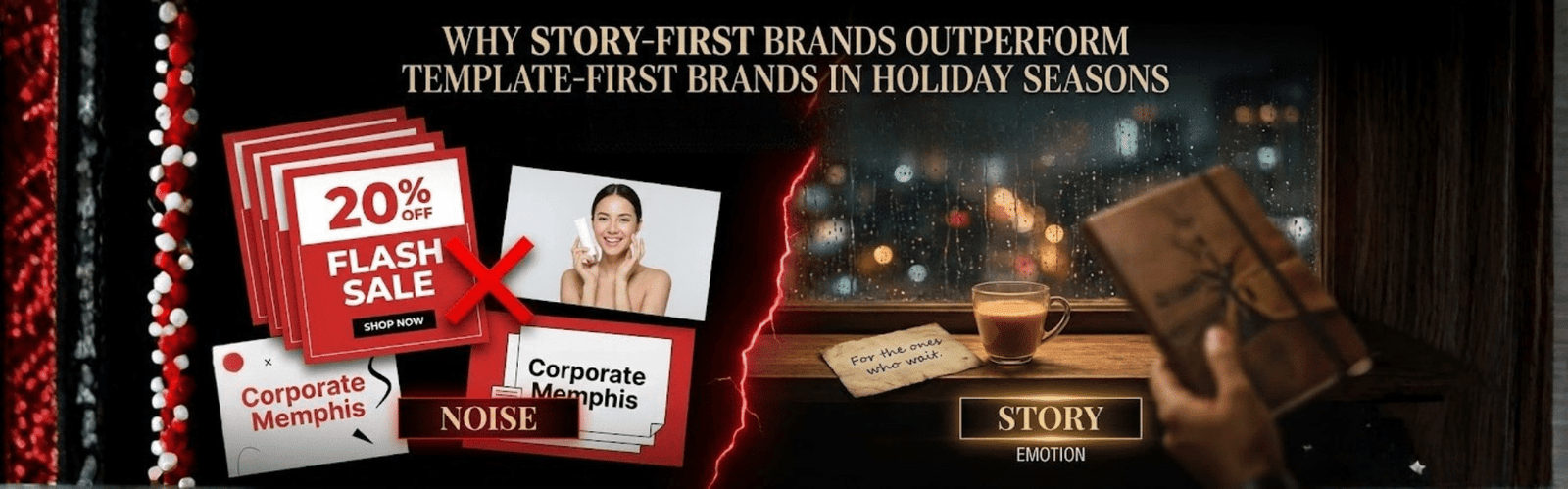
It is December 10th. Your customer is scrolling through Instagram at 140 miles per hour.
They see a red square with white text that says “20% OFF.”
Then another one.
Then another one.
Then they see a cinematic video of a rain-soaked window in Mumbai, a half-drunk cup of chai, and a handwritten note that says, “For the ones who wait.”
The first three images were Templates. The brain filtered them out as “Noise.”
The fourth image was a Story. The brain stopped decoding it.
In 2025, we are living through the “Great Homogenization.” Tools like Canva and generic AI generators have made it easy to create “professional” looking content. But when everyone looks professional, no one seems special. “Polished” is no longer a signal of quality; it is a signal of automation.
To win this holiday season, you must reject the “Template-First” mindset, which prioritizes efficiency, and embrace the “Story-First” mindset, which prioritizes Resonance. This guide explains the neuroscience of why templates fail, and how to use AI to scale bespoke storytelling that feels handcrafted.
The Neuroscience of Boredom: Why the Brain Ignores Templates
To understand why templates don’t convert Christmas shoppers, we must look at the Reticular Activating System (RAS) in the human brain.
Pattern Recognition & Deletion
The brain is an energy-conservation machine. To save calories, it aggressively filters out “known patterns.”
- The Template: A stock photo on the left, bold text on the right, a “Shop Now” button at the bottom.
- The Brain’s Reaction: “I have seen this pattern 10,000 times. It is an ad. It is neither a threat nor a reward. Delete.“
This is Banner Blindness evolved. In 2025, users don’t just ignore banners; they ignore styles. They ignore the “Corporate Memphis” flat art style. They ignore the “Perfectly Lit Studio Shot.”
The “Pattern Interrupt” (The Glitch)
A Story-First asset breaks the pattern.
It introduces an “Information Gap.”
- Visual: A photo of a hoodie lying on a wet sidewalk.
- The Brain’s Reaction: “Why is it on the ground? Is it abandoned? Who left it? I need to investigate.”
- Result: The user stops scrolling. Attention is captured not by “Clarity,” but by Intrigue.
The “Template-First” Fallacy: Efficiency vs. Effectiveness
Most small businesses fall into the Template Trap because they are chasing Efficiency.
“I can make 30 posts in 30 minutes using this Canva template!”
The Problem: You are efficiently producing garbage.
In holiday marketing philosophy, Volume $\times$ Zero Resonance = Zero Sales.
The “Commoditization of Polish”
Ten years ago, a clean design signaled “Trust.”
Today, a clean design signals “Drop-shipper.”
Because AI tools can generate “Perfect” layouts instantly, perfection has lost its value.
Imperfection is the new luxury.
- Template-First: Prioritizes speed, consistency, and safety.
- Story-First: Prioritizes emotion, texture, and specific identity.
The shift: You must stop asking, “Does this look professional?” and start asking, “Does this feel like us?”
The “Story-First” Physics: Character, Conflict, Resolution
How do you apply AI storytelling for holiday brands without writing a novel?
You use the 3-Act Structure in micro-content.
Act 1: The Character (Identity)
Templates have no character. They are voids waiting for a logo.
Story-First content starts with Who.
- The Social Scion Example: The character is “Dev.” He is cynical about hype, loves Mumbai rain, and values creativity.
- Application: Every product shot must imply Dev was just there. A half-eaten samosa on the table. A specific pair of sunglasses reflecting the screen.
Act 2: The Conflict (Tension)
Templates present solutions without problems. “Here is a great gift!”
Story-First content presents Tension.
- The Conflict: “The anxiety of buying a gift that ends up in a drawer.”
- The Visual: A shot of a pile of generic, unopened gift boxes gathering dust.
- The Caption: “Don’t add to the pile.”
Act 3: The Resolution (The Product)
The product is the tool that resolves the tension.
- The Resolution: The “Storytelling Kit” that unlocks creativity.
- The Visual: A clean, glowing workspace amidst the chaos.
Story-first Brands: Using AI to Break the Grid
We don’t use AI to fill templates. We use AI to destroy them.
Here is the festive marketing strategy insights workflow for generating “Anti-Template” creative.
The “Chaos Composition” Prompt
Templates rely on grids (Rule of Thirds, Centered).
Instruct Midjourney to use Dynamic Composition.
The Prompt:
“Cinematic photography. Composition: Dutch angle, off-center subject, chaotic foreground elements. Subject: A hand holding [Product] in the bottom right corner, mostly obscured by rain on a window. Focus: The background city lights are in bokeh. Vibe: Candid, accidental, voyeuristic. –ar 4:5 –style raw”
Why this works: It looks like a “found photo,” not a “made ad.” It feels native to the user’s feed (which is full of their friends’ chaotic photos), so it bypasses the “Ad Filter.”
The “Texture Overlays”
Templates are flat. Stories have texture.
- Action: Use AI to generate “Film Burn,” “Dust,” “Water Damage,” or “Paper Fold” textures.
- Application: Overlay these on your pristine product shots.
- The Signal: “This object exists in the real world. It has history.”
Visual Strategy for Holiday Season: The “Anti-Canva” Aesthetic
Brand differentiation holiday season relies on being visually distinct from the “Canva Look” (Bright colors, geometric shapes, Sans Serif fonts).
1. Lighting: Chiaroscuro vs. Ring Light
- Template: Ring Light (Even, flat, shadowless).
- Story: Chiaroscuro (Deep shadows, shafts of light).
- AI Command: High contrast, volumetric lighting, deep shadows, Rembrandt lighting.
2. Typography: The “Typesetter” vs. The “Font”
- Template: Centered “Montserrat” font.
- Story: Asymmetrical typography that interacts with the image.
- Strategy: Use AI to generate the image with negative space, then use Photoshop to place text behind objects (masking) or wrapped around curves. This 3D integration proves a human touched it.
3. Color: The “Desaturated” Palette
- Template: Hex #FF0000 (Christmas Red).
- Story: Hex #8B0000 (Oxblood) or #2F4F4F (Dark Slate).
- Strategy: Use “Analogous” colors that blend, rather than “Complementary” colors that pop. “Pop” is cheap. “Blend” is expensive.
Holiday Season Case Study: The “Perfect” Ad vs. The “Real” Ad
Let’s look at two campaigns for the same product: The Christmas Storytelling Kit.
Campaign A: Template-First (The Failure)
- Visual: A stock photo of a laptop with the Kit on screen. A red border. Text: “FLASH SALE 50% OFF.”
- Copy: “Get the ultimate kit now! Limited time only!”
- Result: 0.8% CTR. High bounce rate.
- Why: It looks like spam. It asks for value (money) without offering context.
Campaign B: Story-First (The Winner)
- Visual: A POV video (AI-generated motion). It’s 2 AM. Rain is hitting the window. A laptop screen glows blue in the dark room, displaying the Kit’s interface. A lofi beat plays. No text overlay.
- Copy: “It’s 2 AM. You have the idea. You just need the structure. The Storytelling Kit is your architecture.”
- Result: 3.4% CTR. High conversion.
- Why: It sells the moment of use. It sells the identity of the “Night Owl Creator.”
The Technical Workflow: Prompting for Irregularity
To achieve emotional branding vs template use, you must fight the AI’s tendency to be perfect.
The “Style Raw” Parameter
In Midjourney, standard mode adds a “beautification” filter.
–style raw removes it.
- Prompt: A messy desk, coffee stains, crumpled paper, [Product] in center –style raw
- This generates “Ugly-Beautiful” images that feel authentic.
The “Aspect Ratio” Hack
Templates are usually Square (1:1) or Portrait (4:5).
Break the feed by using Cinematic Ratios inside a square container.
- Strategy: Generate an image at –ar 2.39:1 (Anamorphic Widescreen).
- Post: Place this widescreen image on a black square background with white subtitles below it.
- Effect: It looks like a movie screenshot. It signals “Cinema,” not “Ad.”
The Long-Term ROI: Building Equity vs. Extracting Cash
Holiday season marketing strategy insights often focus on Q4 revenue.
But Story-First branding focuses on Q1 retention.
The Memory Structure
- Template Marketing: Is transactional. Once the sale is over, the relationship ends. I bought the socks because they were cheap. I have no loyalty to the sock template.
- Story Marketing: Is relational. I bought the socks because I want to be part of the “Arctic Weaver” story.
- The Q1 Effect: When you launch a new product in January, the Story customer returns. The Template customer has already moved on to the next discount.
The “Un-Copyable” Moat
Competitors can copy your Template in 5 seconds.
Competitors cannot copy your Story.
If you build a world where “Dev” explores “Mumbai” to find “Digital Artifacts,” a competitor cannot steal that without looking like a ridiculous clone. Story is the ultimate defensive moat.
When Holiday Season Gets Too Abstract
There is a danger. You can get so lost in the “Vibe” that you forget to sell.
The “Abstract vs. Concrete” Rule:
- Visuals: Can be Abstract (Mood, Vibe, Story).
- CTA (Call to Action): Must be Concrete.
- Bad: “Join the journey.” (Too vague).
- Good: “Get the Kit. Start writing tonight.”
The “Hero Shot” Requirement:
Even in a story, the product must be the “Hero.”
- Don’t hide the product too much in shadows.
- Use “Rim Lighting” to ensure the silhouette of the product is always visible, even in a dark, moody scene.
FAQ: Scaling “Bespoke”
Q1: Creating bespoke stories takes too long. How do I scale this?
A: You scale the Assets, not the Story.
- Create one core story for the week (e.g., “The Midnight Writer”).
- Use AI to generate 20 variations of visuals for that one story.
- Use “Spinax” prompting to rewrite the caption 20 times.
- You are telling one story in many ways, not inventing a new story every hour.
Q2: Does this work for low-cost items?
A: Yes. Liquid Death sells water (a commodity) using heavy storytelling. They don’t use templates. They use “Murder Your Thirst” narrative. They outperform every template-based water brand.
Q3: My design skills are bad. Can I still do this?
A: AI is your designer. You don’t need to know how to layout type in InDesign. You need to know how to describe a “Film Noir Poster” to Midjourney. Your taste is the skill, not your mouse clicks.
Conclusion: The Human Signal
In the age of AI, “Template” = “Robot.”
“Story” = “Human.”
Ironically, we are using robots (AI) to create the story. But the intent is human.
The template says, “I want your money efficiently.”
The story says, “I want to share a world with you.”
This holiday season, the brands that look like “Businesses” will struggle.
The brands that look like “Filmmakers,” “Artists,” and “Vloggers” will win.
Burn the templates. Film the movie.
Bonus: The “Anti-Template” Prompt Pack
1. The “Cinematic Screenshot” (Visual)
“DVD screengrab from a 1990s thriller movie. A close up of a hand passing a [Product] to another hand in the rain. Streetlights reflecting on wet pavement. Subtitles at the bottom say: ‘Take it. It’s dangerous to go alone.’ –ar 16:9 –style raw”
2. The “Found Object” (Visual)
“Polaroid photo lying on a wooden desk. The photo shows [Product] sitting on a beach. The desk has coffee rings and a set of keys. Realistic lighting. Flash photography style. –ar 4:5”
3. The “Narrative Caption” (Copy)
“Don’t write an ad. Write a diary entry from the perspective of someone using [Product] on Christmas Eve. Start with: ‘It was finally quiet.’ End with: ‘This was the only thing I needed.’ Tone: Intimate, whispered.”